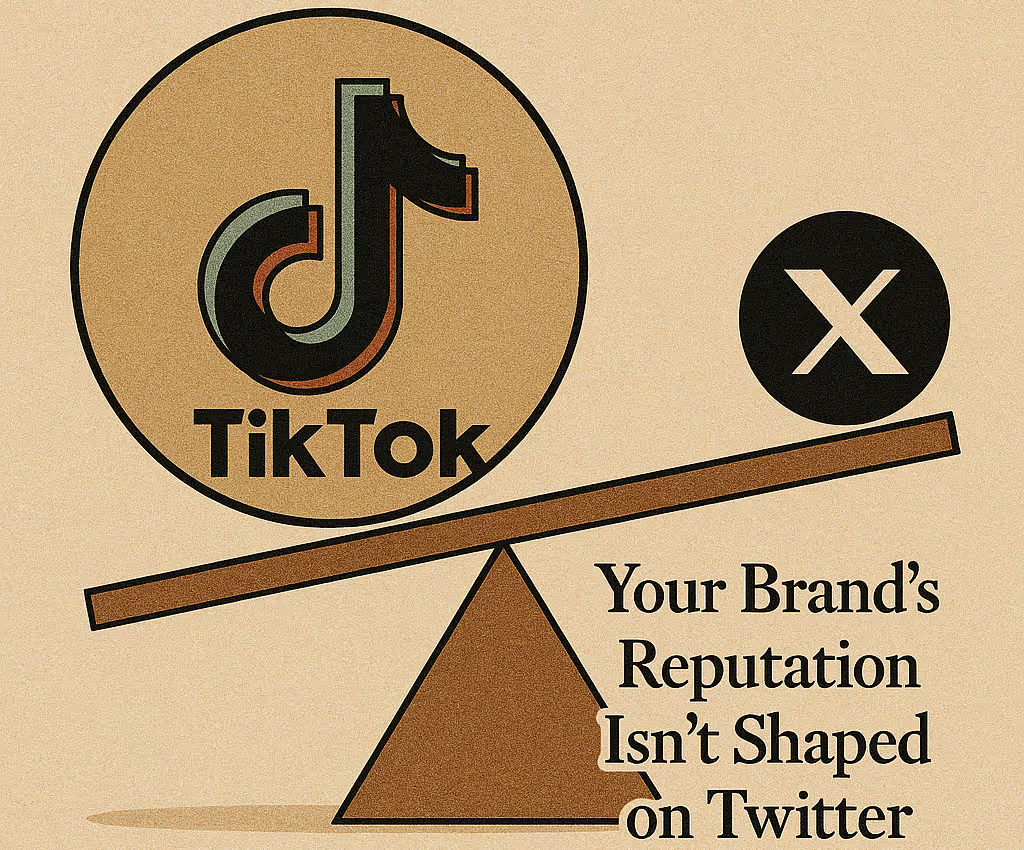
Why Twitter isn’t Representative of Content on Other Platforms - Part 4
In Part 3: Going Beyond Post Titles, Descriptions, and APIs – How Pendulum Intelligence Gets the Data That Matters, we explored how traditional search-based monitoring methods fail to capture the full scope of brand mentions across video, audio, and image-driven platforms.
But even if a company has improved its data collection, many brands still will likely make a crucial mistake if they assume that Twitter (X) is the most reliable proxy for broader social media trends.
Many social media analysts recognize that Twitter (X) is much smaller than YouTube, TikTok, and Instagram. However, some still argue that Twitter alone provides a representative sample of content across social platforms. This belief is far from true.
As media theorist Marshall McLuhan famously stated, “The medium is the message.” Twitter (X) is fundamentally different from video-, image-, and audio-driven platforms. The types of content, the way it spreads, and the audience engagement on Twitter differ significantly from those of TikTok, YouTube, and Instagram.
In Part 4, we explore the stark differences in the content types that mention brands across major platforms. Additionally, we examine the coverage of brand-related topics—such as boycott movements—to highlight how discussions vary significantly across different platforms.
Analyzing Fundamentally Different Content Types
Using the dataset from the analysis in Part 2 of our blog post series, we used Pendulum's social intelligence to examine the types of content creators that discussed or mentioned 20 randomly selected Fortune 500 companies. Instead of using traditional content creator categories, we categorized channels by content type. For instance, channels reviewing phones or cars were grouped under “Reviews” rather than being split into “Electronics” and “Auto.”
For each company, we analyzed the top 200 channels (by follower count), mentioned them, and assigned up to three of the 15 predefined content-type tags. Our findings show that while Twitter (X) dominates News coverage, it has minimal representation in other critical content categories, such as vlogs, lifestyle, and reviews.
These content types significantly influence brand perception, yet Twitter lacks meaningful engagement with them. This demonstrates that relying on Twitter for brand monitoring misses key types of content that affect consumers' impressions of your brand.
Differing Coverage for the Same Topic
To further illustrate the gap between Twitter (X) and other platforms, we analyzed boycott movements targeting the ten most-boycotted brands from July 2023 to 2024. Our study focused on spikes in boycott-related content across Twitter (X), TikTok, and YouTube.
Key findings include:
- Seven out of ten companies experienced at least one period during which boycott content surged on TikTok and YouTube, but not on Twitter.
- Three out of ten companies saw the opposite pattern—a spike in boycott discussions on Twitter without a corresponding rise on TikTok or YouTube.
- Only two out of ten companies had the exact same periods of boycott spikes across Twitter and TikTok / YouTube.
This data directly refutes the idea that Twitter content is representative of broader social media trends. For crucial brand-related topics, such as boycott movements, relying on a single platform for insights can lead to missed discussions that could significantly impact a company’s reputation.
Why do Brands Need Multi-Platform Social Listening and Intelligence?
Twitter (X) is not a proxy for social media as a whole. The platform is uniquely dominant in news-related discussions but lacks coverage in other vital content categories, such as lifestyle vlogs and product reviews. Furthermore, major brand-related discussions—such as boycott movements—often surge on one platform while remaining dormant on another.
For brands and analysts, relying solely on Twitter for social media insights is a flawed strategy. A comprehensive approach that includes multiple platforms is essential to accurately gauge consumer sentiment, brand perception, and emerging trends.
By using Pendulum to understand each platform's unique content landscape, businesses can make more informed decisions and avoid the pitfalls of narrow, Twitter-centric analysis.
Download our 2026 Trend Report to learn more about building better brand command in 2026.
How to Stay Ahead with AI-Powered Brand Monitoring
Understanding how brand conversations vary across platforms is essential, but the next challenge is to filter out the noise and focus on what truly matters.
Want to see how our AI-driven social intelligence platform can revolutionize your brand monitoring?
Request a demo today and gain deeper insights across video, audio, and image-based platforms.
See the Rest of this 4-Part Series:
Want to know how your social listening strategy stacks up? Take our free social intelligence audit!
Related Articles
Explore deeper insights and practical perspectives related to this topic.


Times Have Changed. So Should Your Tech Stack
See how brands are upgrading their strategies with Pendulum Social Intelligence.